AI in Music 2025: Transforming Creation and Industry
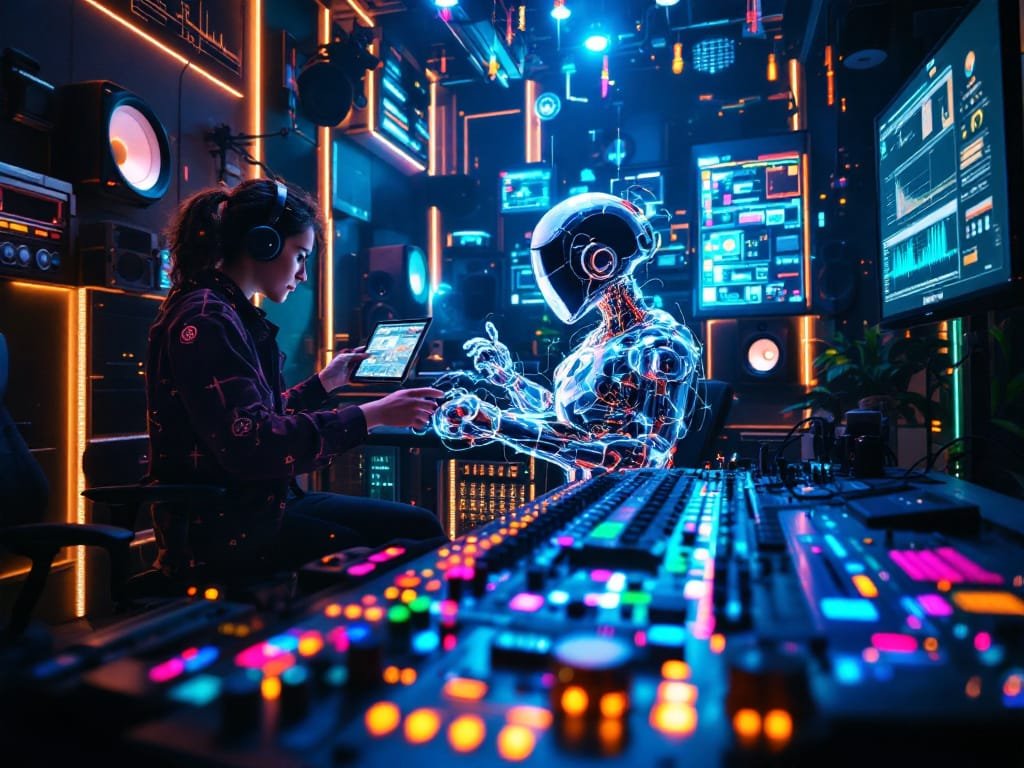
It’s 2025, and AI has become a big player in the music world. This isn’t just some flashy tech gimmick anymore – AI is now writing hit songs, helping unknown artists find fans, and making us question what musical creativity really means. As these AI tools get smarter, we’re watching a total shake-up in an industry that loves new tech but has always held tight to its human roots.
What is the future of AI in the music industry?
AI has crashed the music production party at warp speed. Almost 37% of music producers now use AI in their work – a number that would’ve seemed crazy just a few years back. And this train ain’t slowing down!
The money tells an even better story. By 2033, the AI music industry should hit a mind-blowing $38.71 billion. That’s one of the biggest tech booms the industry has ever seen! By 2025, AI will likely bump music industry revenue up by 17.2% – mostly from AI-made music and better production tools.
Several key AI platforms are leading this transformation:
- AIVA (Artificial Intelligence Virtual Artist) – Specializing in orchestral compositions, AIVA can generate complete symphonic works that are increasingly difficult to distinguish from human compositions.
- MuseNet – Built by OpenAI, this deep neural network can generate 4-minute compositions with 10 different instruments across diverse genres and styles.
- Amper Music – Focusing on accessibility, Amper allows users without musical training to create professional soundtracks by selecting mood, style, and length parameters.
- Google’s Magenta – This open-source research project explores the role of machine learning in creative processes, producing tools like NSynth for generating entirely new sounds.
These AI tools are showing up more and more in mainstream music. Big record companies now use AI to spot trends, make background tracks, and even find potential hits before they’re finished. Rolling Stone reports that many major labels now use AI in their talent scouting, changing how new artists get discovered.
How are musicians adapting to AI technology?
Musicians have gone from “AI is scary” to “AI is my buddy” pretty fast. Smart artists now see AI as a helper, not a threat. They use it to boost their creativity while keeping their own unique style.
In this new world, AI works as a creative partner. Artists use it to get fresh ideas when they’re stuck or to explore weird musical paths they might’ve missed. This team-up lets musicians keep their identity while pushing boundaries with AI’s help.
Several notable artists have embraced AI in their work:
- Taryn Southern – Released “I AM AI,” an album composed entirely in collaboration with AI platforms including Amper Music.
- Holly Herndon – Created “Spawn,” an AI baby trained on her voice and those of her ensemble to create uncannily human-like vocal performances.
- David Guetta – Has incorporated AI-generated vocals mimicking performers like Eminem in his live performances, demonstrating AI’s potential for real-time implementation.
- Bjork – Collaborated with Microsoft AI for an installation that produced evolving musical arrangements based on weather patterns and cloud formations.
Finding the sweet spot between human creativity and AI help takes some skill. Most success stories involve artists steering the AI rather than giving up control. They typically use AI outputs as starting points, then apply their own judgment to polish and personalize the results. This mix-and-match approach keeps the emotional realness that fans want while opening up new possibilities.
Not everyone loves AI in music, though. Many folks don’t really get what AI can and can’t do, and some worry about losing their jobs. Some artists think AI threatens real human expression. Others stress about their hard-earned skills becoming less valuable.
Musicians are getting over these fears by learning, trying things out, and slowly bringing AI into their work. Many start small – maybe using AI for simple drum beats or backing tracks before trying bigger stuff. As they see benefits without losing their artistic voice, the fears usually fade.
Will AI ever replace human artists?
As AI gets better at making music, we gotta ask: Could robots replace human musicians someday? The truth needs a look at both what AI can and can’t do.
AI is crazy good at technical stuff—perfect performances, complex harmonies, and fancy mathematical compositions. But AI sucks at true artistic innovation that breaks rules in ways that make sense. It can copy existing styles or mix them together, but rarely creates something totally revolutionary that changes how we think about music.
The emotional depth between human and AI music is night and day. Human songs come from life experience, culture, personal struggles, and real emotions. AI just works from patterns it sees in other music. This creates a big problem for AI trying to express real emotion or tell genuine stories through songs.
This shows up super clear in lyrics. AI can write words that rhyme and stick to themes but rarely hits you in the feels like human lyrics can. As ANR Factory notes, “While AI can generate lyrics that follow structural rules, they often lack the raw emotional authenticity that makes lyrics truly connect with listeners.”
The future probably won’t be AI replacing humans, but humans and AI working together. AI can handle techy stuff like sound design and production while humans bring creative direction, emotion, and cultural context. This teamwork uses the best of both human creativity and computer power.
What we’re seeing is different levels of AI involvement in music—from small technical help to big creative input. This range lets artists choose how much they want to work with AI based on their goals, technical needs, and personal taste.
AI-Powered Songwriting and Production Tools
Composition algorithms have come a long way, baby. Early AI music tools were dumb rule-followers with limited style. Today’s tools use deep learning trained on tons of music, helping them understand complex patterns in harmony, melody, rhythm, and structure across many genres.
Modern AI can now write music that follows theory rules while sounding like specific artists, eras, or genres. Some fancy systems can even figure out what emotions music creates and write songs to make you feel certain ways.
AI production tools have also jumped way beyond simple beat-making. Today’s AI production tools can:
- Generate realistic-sounding virtual instruments that respond dynamically to composition parameters
- Create custom sound designs by analyzing and transforming sample libraries
- Handle complex mixing tasks including EQ, compression, and spatial positioning
- Master tracks to professional quality standards, adjusting frequency balance and dynamic range
- Analyze vocal performances and apply appropriate effects and tuning
These tools knock down technical walls, letting creators focus more on creative choices than technical stuff.
The biggest win from AI music tools might be how they level the playing field. Making pro music used to need expensive gear, special training, and music education. Now AI tools let people with limited resources create pro-quality music. This opens doors for talent in underrepresented communities or places without good music education.
A survey found 64% of indie musicians think AI tools have knocked down barriers to music production. 71% said they finished projects they couldn’t have done without AI help.
But with these cool tools come hairy copyright questions. Copyright law was built around human creators, making AI-generated music legally murky. Big questions include:
Who owns AI-created music? The AI developer, the user, or both? If an AI trained on copyrighted songs creates new music, is that stealing? How should money be split for AI music that makes money?
The industry is still figuring this out. Some platforms offer royalty-free licenses for AI content while others split revenue among various stakeholders.
Ethical Implications of AI in Music
AI music creation has thrown a wrench in traditional copyright laws. Most copyright laws require human authors, leaving AI-made music in a weird legal limbo.
Several sticky questions have popped up:
- When an AI makes music based on its training data (which includes copyrighted songs), is the output derivative or transformative?
- If an AI copies a specific artist’s style, is that stealing their artistic identity?
- Who owns songs created through human-AI teamwork, especially when the AI did a lot of the heavy lifting?
Some legal nerds want new copyright categories just for AI-generated stuff. Others think we should expand fair use rules to handle these new creative processes.
Beyond legal headaches, figuring out fair payment is another big mess. Traditional royalty systems weren’t built with robot composers in mind. Some proposed solutions include:
- Attribution licenses: Requiring acknowledgment of AI involvement while allowing free use
- Fractional royalty distribution: Dividing royalties between human creators, AI platform developers, and original artists whose work informed the AI
- Training data compensation: Paying artists whose work is used to train AI systems through collective licensing arrangements
These models try to ensure everyone gets paid fairly while recognizing that humans and AI now make music together.
Job loss fears are real too. As AI gets better at tasks normally done by session musicians, producers, engineers, and composers, people worry about their careers.
A recent survey showed 42% of music pros worry about AI taking jobs. Studio musicians and mastering engineers were the most nervous. But history shows that when some jobs disappear, new ones often pop up—like AI prompt engineering, AI output curation, and specialized AI-human production roles.
Finding balance between innovation and artistic integrity ain’t easy. The music world has always valued authenticity and human expression – qualities that might get lost if AI goes wild. As noted by The Guardian, big stars like Billie Eilish and Nicki Minaj have warned that too much AI might kill the “soul” of music.
Creating ethical guidelines for AI music will need ongoing talks between tech people, artists, lawyers, and industry big shots. Several music organizations have started developing frameworks that push for transparency in AI use, fair pay for everyone involved, and keeping human creativity at the center.
The Future of AI-Enhanced Music Experiences
Tomorrow’s music listening will be super personalized, thanks to AI. Streaming platforms are building systems that go way beyond genre-based playlists to create deeply customized experiences that match your mood, activity, and environment.
Next-gen AI recommendation algorithms might use your biometric data (with privacy protections) to suggest music matching how your body feels. Some platforms already test mood detection through your phone camera to adjust playlists. By 2025, systems might create entire listening journeys designed for specific activities or emotional experiences.
Dynamic playlists that change with your day will become normal, with AI checking your location, calendar, and activity to predict what music fits each moment. Music could flow from energizing morning tunes to focus-enhancing work beats to chill evening sounds without you doing anything.
Live concerts are also getting an AI makeover. Interactive shows where crowd reactions change the performance in real-time are being tested in some venues. These systems track crowd energy, movement, and even facial expressions to adjust lights, visuals, tempo, and song choice.
Virtual performances will keep growing beyond pandemic necessity to become legit artistic venues. Advanced systems will let virtual performers and audiences interact more naturally, blending physical and digital musical worlds.
Artists will use AI for wild stage shows, with real-time responsive visuals and sound tweaks creating immersive experiences impossible in old-school concerts. Some pioneers already use AI systems that generate visual art responding to music as it’s played.
AI is flipping music marketing on its head. Predictive analytics now spot emerging trends and untapped audiences with crazy accuracy, allowing for laser-targeted promotion campaigns.
Natural language processing lets computers create content across multiple platforms, making social media posts, press releases, and marketing copy that keeps consistent branding while reaching different groups. This helps indie artists run sophisticated marketing that used to need whole teams.
AI chatbots and custom content keep fans engaged between releases and shows. Some artists now use systems that send personalized messages and content recommendations based on each fan’s likes and interaction history.
Global teamups are getting easier too. Real-time translation and cultural context tools help artists from different countries work together despite language barriers. These systems translate not just words but also cultural references and slang to keep the intended meaning.
Cloud-based production platforms with AI eliminate geographic limits on creative partnerships. These platforms sync contributions from multiple locations while offering AI suggestions to fix potential creative conflicts or technical issues.
Conclusion
As we look to 2025, AI isn’t just changing how music gets made—it’s reshaping what we think creativity even is. The tech has grown from simple computer composition to smart creative partnership, opening new doors while raising big questions about art, authenticity, and what makes music touch our hearts.
The winners will be folks who don’t blindly worship or reject AI, but thoughtfully blend it into their creative process while keeping the human touch that gives music its emotional punch. The future belongs to the middle ground—where tech makes human creativity stronger rather than replacing it.
For listeners, this change promises richer, more diverse music and deeply personal experiences. For creators, it offers powerful new tools while challenging them to keep their unique voice. And for the industry as a whole, it means creating new frameworks for copyright, artist payment, and ethical use.
The AI music revolution of 2025 won’t be about machines taking over—it’ll be about humans and machines making music together in ways neither could pull off alone.
Share this content: