When Will AI Robots Enter Our Homes? 2025 Outlook
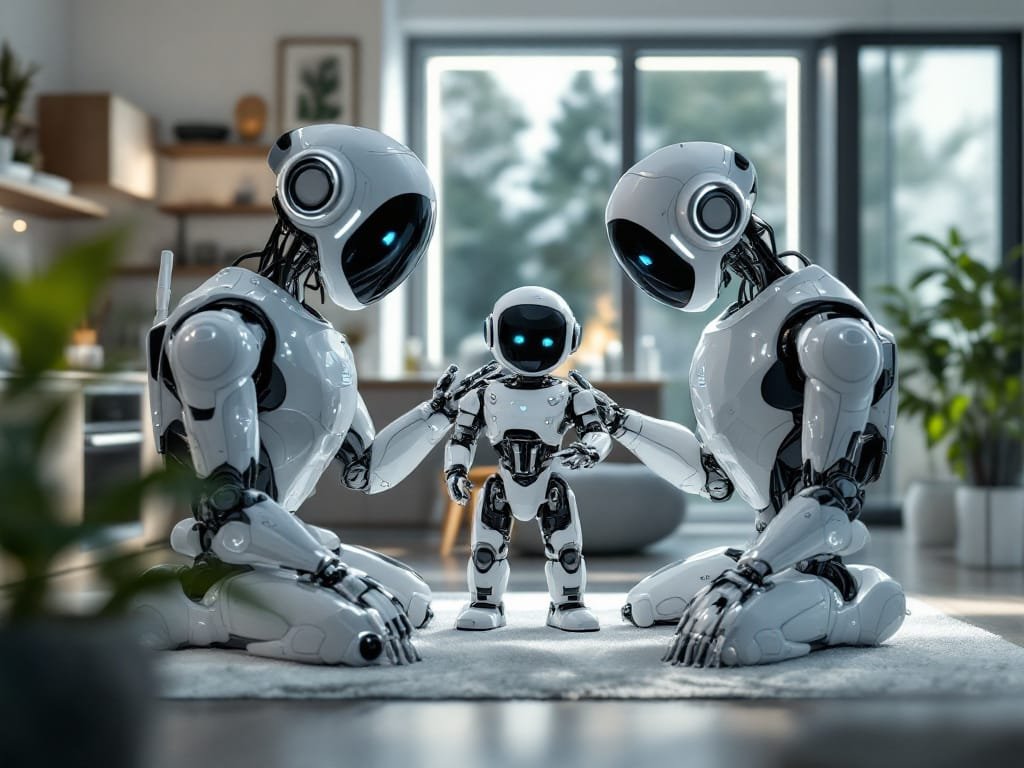
The robotic butler bringing you coffee in the morning. The humanoid that folds your laundry while you’re at work. These sci-fi images have teased us for decades—always just around the corner but never arriving. But as 2025 approaches, the gap between sci-fi dreams and your living room is shrinking fast. Recent AI and robotics breakthroughs have sped things up, making many of us wonder: when exactly will these metal helpers move in with us?
How Long Until AI Robots Become Available to the Public?
Don’t expect to circle a specific date on your calendar. Robot integration will creep into our lives gradually rather than arrive with a big product launch. To guess when we’ll see robots everywhere, we need to look at where things stand now.
Current state of AI robotics development
Today’s home robots mostly do just one thing. Roomba vacuums, which have been around for 20+ years, are the biggest robot success story with over 40 million units sold. Smart speakers brought AI into our homes, but they can’t move around or pick things up—key features of true robots.
The coolest robots still live in labs and factories. Boston Dynamics’ Atlas can do backflips but isn’t for sale. Meanwhile, simple robot vacuums and lawnmowers have proven themselves useful in regular homes.
The main problem isn’t just the AI brains but getting those brains to work with capable robot bodies. As of now, we have:
- Fancy research and factory robots
- Simple helper robots that do basic tasks
- Test-phase humanoid robots stuck in labs
But the all-purpose home helper robot that can do many different tasks? Still cookin’ in the lab.
Major companies leading humanoid development
Several big players are racing to build humanoid robots:
- Tesla: Elon’s Optimus robot aims to do all sorts of tasks. Tesla’s using its AI know-how and battery tech to build robots that might first work in Tesla factories before hitting your home.
- Boston Dynamics: Their new Atlas is electric, lighter than before, and moves better than any other robot out there.
- Figure AI: They just teamed up with OpenAI to put advanced language smarts into their Figure 02 robot, and they’re building new versions really fast.
- Apptronik: Their Apollo robot is built with mass production in mind, targeting businesses first.
- Agility Robotics: Their Digit robot has weird ostrich legs that focus on walking efficiency rather than looking human.
Meanwhile, big tech companies like Samsung and LG are working on their own home robots, and tons of startups are jumping in with niche solutions.
Timeline projections from industry experts
According to a Citi GPS report, we’ll likely see 1.3 billion AI robots by 2035 and 4 billion by 2050. This counts all robots though, not just the human-shaped ones.
For actual humanoid home robots, most experts predict:
- 2025-2027: First buyable humanoid robots for businesses and rich tech geeks
- 2027-2030: Better robots that can do more stuff at somewhat lower prices
- 2030-2035: Upper middle-class families start buying them
- 2035-2050: Robots become common across most income levels
These guesses assume steady progress in fixing current problems. But as we’ve seen with self-driving cars, unexpected roadblocks can blow up timelines completely.
What Will AI Robots Cost When Available?
Price ranges for different types of robots
Like most tech, we’ll see different robots at different price points. Current robot prices give us some clues:
| Robot Type | Current Price Range (USD) | Projected 2025-2030 Price Range |
|---|---|---|
| Single-purpose robots (vacuum, mowing) | $200-$1,500 | $150-$1,000 |
| Basic companion robots (limited mobility) | $500-$3,000 | $300-$2,000 |
| Service robots (restaurant, retail) | $5,000-$20,000 | $3,000-$15,000 |
| Basic humanoid robots | $20,000-$100,000 | $10,000-$50,000 |
| Advanced humanoid robots | $100,000+ | $50,000-$150,000 |
For some context, the first personal computers cost about $2,000 in 1977 (equal to roughly $10,000 today), while you can get way better computers now for a few hundred bucks. Robot prices will drop too, but more slowly since they’re more complicated to build.
Factors affecting consumer pricing
Several things will determine how fast robot prices drop:
- Manufacturing scale: Make more robots, cost per robot goes down. Simple math.
- Component standardization: Custom one-off parts will give way to mass-produced standard parts.
- Material innovations: New materials could make robots lighter, tougher and cheaper.
- Battery technology: Better batteries will cut costs and let robots run longer between charges.
- Software distribution model: You might pay for robot AI services monthly, making the hardware cheaper upfront.
Business models might shift too. Companies could sell robots cheap but charge monthly for premium features—kinda like how phones work with service plans.
Cost-benefit analysis for household adoption
People will buy robots if the value beats the cost. Time savings is one way to measure this:
- Cleaning tasks: 5-10 hours/week
- Laundry management: 3-7 hours/week
- Meal preparation: 7-14 hours/week
- Errands and organization: 3-8 hours/week
If we value time at average US wages ($25-35/hour), a robot saving 10 hours weekly is worth $250-350 per week or $13,000-18,000 yearly.
Extra benefits include better quality of life, help for older or disabled people, and having assistance anytime you need it. These perks help justify the cost, especially as prices drop.
Will We See Widespread Robot Adoption by 2030?
Projected market penetration rates
Robot adoption will likely follow an S-curve like other tech—slow at first, then taking off once they get cheap and good enough.
Based on how other technology spread and industry forecasts, we might expect:
- By 2025: 1-3% of households in rich countries might have mobile robots beyond just vacuums.
- By 2027: 5-7% of homes as tech lovers buy first-gen home robots.
- By 2030: 10-15% of homes in wealthy countries could have multi-function robots or basic humanoids.
For perspective, smartphones jumped from under 5% in 2007 to over 80% in rich countries within ten years. Robots will spread slower because they cost more and take up physical space.
Some places will adopt faster—Japan, South Korea, Singapore, and tech hubs in North America and Europe will lead the pack.
Technological advancements expected by 2030
By 2030, several tech breakthroughs should drive more people to buy robots:
- Advanced manipulation: Robots will handle more household items with greater skill.
- Better navigation: They’ll move through cluttered homes without getting stuck or requiring “robot-proofing.”
- Improved human-robot interaction: Better language understanding and emotional intelligence will make robots easier to talk to.
- Energy efficiency: Longer-lasting batteries will let robots work all day without dying.
- Learning capabilities: Robots will learn your specific preferences and home layout over time.
These improvements will make robots much more valuable to average people, worth their high price tags.
Adoption barriers and catalysts
Despite technical progress, several speedbumps might slow robot adoption:
- Cost: High prices will keep early robots limited to rich people.
- Trust and safety concerns: Worries about malfunctions, privacy issues, and security risks.
- Home adaptation requirements: Most homes weren’t designed with robot movement in mind.
- Technical limitations: Early robots won’t match human helpers in skill or flexibility.
- Social resistance: Some folks will be weirded out by robots in their personal spaces.
On the flip side, several factors could speed things up:
- Aging population: More old people needing help in daily life across rich countries.
- Labor shortages: Hard to find people willing to clean homes or provide care.
- Technology normalization: Growing comfort with AI through Alexa, Siri and other assistants.
- Remote work: People wanting cleaner homes while they’re actually at home more.
- Entertainment value: Beyond usefulness, robots offer coolness factor and status symbols.
Government programs could also affect adoption. Countries like Japan actively push robotics to deal with their aging crisis.
The Evolution of Humanoid Robotics
From Asimo to modern humanoids
Looking at humanoid robot history helps us understand where we’re headed. Honda’s Asimo, first shown in 2000, was a huge milestone with its ability to walk on two legs, climb stairs, and recognize faces.
Despite 20+ years of work and 11 different versions, Asimo never made it to stores before Honda killed the program in 2022. This shows an important truth: cool tech demos don’t automatically lead to products you can buy.
Other big moments include:
- 2016: Boston Dynamics shows Atlas doing backflips and parkour moves.
- 2018: SoftBank’s Pepper robot works in stores as a greeter.
- 2021: Tesla announces its Optimus robot project.
- 2022-2023: Many startups get big money to build humanoid robots.
- 2023-2024: Companies start putting ChatGPT-like AI into robot bodies.
Today’s robots benefit from better materials, batteries, motors, and especially AI that older robots couldn’t use. All these technologies coming together is finally making practical humanoids possible.
Key technological breakthroughs
Several major advances have sped up development:
- Advanced Machine Learning: Deep learning helps robots recognize objects, understand speech, and move around better.
- Large Language Models: Systems like GPT-4 let robots understand instructions and chat more naturally.
- Computer Vision: Huge improvements in seeing and understanding objects make grabbing things easier.
- Sensor Fusion: Combining data from different sensors for better awareness.
- Improved Actuators: Better motors and artificial muscles that move more like humans do.
- Battery Technology: More energy in smaller, lighter batteries means longer running time.
These technologies multiply each other’s effects. Better vision makes grabbing objects easier. Better language models help robots learn from human instructions. The whole becomes greater than the sum of its parts.
Design approaches (functional vs. humanlike)
Two main design philosophies are emerging in robot design:
| Functional Design | Humanlike Design |
|---|---|
| Focuses on practical abilities over looking human | Tries to closely copy human shape and features |
| Examples: Agility Robotics’ Digit with bird-like legs | Examples: Hanson Robotics’ Sophia with realistic face |
| Advantages: Often works better for specific jobs | Advantages: More natural for human interaction and homes built for humans |
| Challenges: May need home modifications | Challenges: Harder to build, might creep people out |
Most robots that actually sell will probably take a middle path—human-shaped enough to work in our homes but not trying to look too realistic. This approach keeps things practical while avoiding the “creepy almost-human” problem.
Hardware and Software Challenges
Current limitations in robot actuators
Robot “muscles” (actuators) might be the biggest hardware bottleneck right now. These components need to balance strength, speed, precision, weight, and power use.
Current problems include:
- Power-to-weight ratio: Human muscles produce about 5 times more power per pound than the best robot actuators.
- Control precision: Fine movements remain tough, especially for delicate tasks.
- Energy efficiency: Most actuators waste 70-90% of their energy as heat, while human muscles are 40% efficient.
- Response time: Many actuators are too slow for quick balance reactions.
- Compliance: The ability to switch between stiff and flexible as different tasks require.
Some promising new technologies might fix these issues:
- Fluid-powered soft materials
- Next-gen electromagnetic motors
- Fake muscle fibers
- Actuators that can change their stiffness
Breakthroughs here could make robots way more capable and cheaper too.
Battery life and power management
Energy needs are another huge challenge. Current humanoid robots typically run for just 1-4 hours before needing a recharge—nowhere near enough for all-day home use.
Major power issues include:
- Energy density: Today’s best batteries hold about 30 times less energy than gasoline by weight.
- Charging time: Fast charging creates heat and wears out batteries faster.
- Weight distribution: Batteries are heavy and make balance harder.
- Power management: Smart distribution of power across systems during different tasks.
New solid-state batteries, energy harvesting, and better power management software will be crucial for practical home robots. Some companies are trying approaches where robots automatically plug themselves in when not busy.
AI integration and learning capabilities
The software challenges might be even tougher than hardware. For robots to be truly useful at home, they must:
- Adapt to different homes without needing reprogramming
- Understand natural commands in context
- Learn by watching rather than requiring programming
- Make good decisions with partial information
- Get better over time through experience
AI systems like GPT-4 are being connected to robot platforms to help with understanding and learning. IEEE Spectrum reports that companies mix human training with virtual simulations to teach robots without needing physical robots for every lesson.
However, skills learned in simulation often fail in the real world (the “sim-to-real gap”). That’s why companies are collecting data from human demos and testing robots in actual homes.
Safety considerations
Safety is non-negotiable for home robots. Key concerns include:
- Physical safety: Preventing crashes, pinches, or other injuries
- Operational reliability: Making sure robots don’t mess up important tasks
- Cybersecurity: Stopping hackers from taking over robots
- Privacy protection: Keeping robot camera and microphone data safe
- Psychological safety: Making interactions comfortable and not scary
Rules for home robots are still being written. The EU’s AI Act and similar rules will shape design requirements, possibly slowing releases but creating safer products.
Manufacturers are building in multiple safety features:
- Sensors that feel when they bump into something
- Backup systems and fail-safes
- Motors weak enough they can’t hurt you even if they malfunction
- Encrypted communications for security
- Processing sensitive data on the robot itself for privacy
Practical Applications in Home Settings
Household tasks robots will perform first
As robots enter our homes, they’ll probably tackle specific jobs before becoming general helpers. The order will likely go something like this:
- Object retrieval and organization: Finding, grabbing, and putting away items
- Surface cleaning: Wiping counters, tables, and other surfaces
- Laundry management: Sorting, folding, and storing clothes
- Basic food preparation: Simple cooking tasks and meal prep
- Monitoring and security: Watching the house and alerting during emergencies
- Elder care assistance: Medication reminders and basic physical help
This order reflects increasing difficulty. Folding different types of clothes is harder than grabbing specific objects. First-gen robots will stick to easier tasks.
Companies will probably sell robots that gain new skills over time through software updates, just like your phone gets new features.
Integration with smart home systems
Robots won’t work alone but as part of your smart home ecosystem. This teamwork has several benefits:
- Environmental awareness: Robots can use data from home sensors to understand what’s happening.
- Extended capabilities: Robots can control smart devices even when they’re across the room.
- Improved efficiency: Coordinating with automated systems (heating, lights, security).
- Simplified user experience: One consistent way to control everything.
A robot might:
- Check your smart fridge’s shopping list to see what you need
- Turn lights on or off without physically flipping switches
- Work with smart locks to let verified visitors in
- Get alerts from washers or dishwashers when cycles finish
This integration will likely use standards like Matter, which was created to make smart home devices from different companies work together.
Addressing the uncanny valley in design
“Uncanny valley” is that weird feeling you get when robots look almost—but not quite—human. It’s an important design challenge for humanoid robots.
Companies are trying several approaches to avoid creeping people out:
- Stylized design: Using cartoon-like features that clearly aren’t trying to be human
- Functional appearance: Focusing on utility instead of human looks
- Expressive minimalism: Simple features that show basic emotions without trying to be realistic
- Transparent operation: Clearly showing what the robot is doing and why
Companies like Figure AI are making robots with human-like bodies but avoiding detailed faces that might trigger the creeps. This balances the advantages of human shape (for working in human spaces) with user comfort.
Research shows people often prefer robots that are clearly mechanical but can still express basic intentions. This preference might change as technology gets better and we get used to having robots around.
Conclusion
Looking toward 2025 and beyond, AI robots are finally moving from sci-fi dreams to actual household helpers. AI advances, hardware improvements, and growing manufacturing capabilities are setting the stage for the first wave of consumer humanoid robots.
While 2025 will likely bring the first buyable humanoid robots, widespread adoption will take longer. Early models will be pricey and limited, appealing mostly to tech geeks and businesses. By 2030, though, we should see more capable and affordable robots reaching more homes, especially for elder care and household chores.
The most successful early home robots won’t try to do everything but will nail specific high-value tasks while playing nice with your existing smart home gear. Like computers and smartphones before them, each generation will do way more while gradually getting cheaper.
Maybe most importantly, our relationship with robots will evolve alongside the tech itself. Cultural acceptance, regulations, and ethical guidelines for human-robot interaction are developing in parallel with the robots themselves. The winners in this space won’t just have cool tech—they’ll be designed thoughtfully to fit into our homes and lives.
The age of personal robots isn’t quite here yet, but for the first time, we can actually see it coming down the road.
Share this content: