Shakey: The First AI Robot and Its Historic Impact
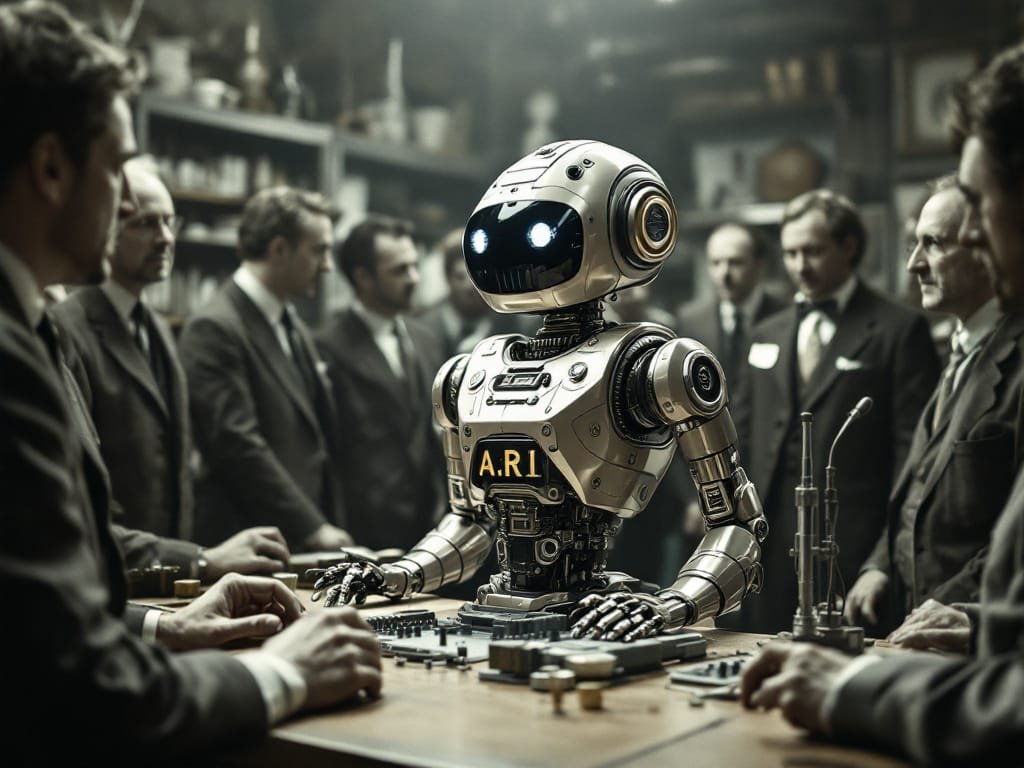
AI has come a long way, but few milestones match the creation of the first true AI robot. Today we have robot vacuums and self-driving cars, but once upon a time, the idea of a machine that could “think” and move by itself was mind-blowing. It all began with a wobbly box on wheels that changed tech history forever.
When Was the First AI Robot Made?
Shakey, the first real AI robot, was built between 1966 and 1972 at SRI International in California. The project was a game-changer, bringing together robotics and AI in ways nobody had tried before.
Charles Rosen kicked off the Shakey project in 1963 with a wild idea: build a mobile machine that could use neural networks with higher-level AI. He wanted to create something that could see its surroundings, make choices, and act on its own – stuff that was pure science fiction back then.
Rosen put together a team of brainiacs including Peter Hart, Nils Nilsson, and Bertram Raphael. They set out to build the world’s first mobile robot with actual AI smarts. Their robot needed to map its environment, plan actions, carry them out without help, and learn from mistakes.
- Understand and model its environment
- Plan actions based on that understanding
- Execute those actions independently
- Learn from its experiences
The name “Shakey” stuck because the robot wobbled when it moved – a quirky flaw that became part of its identity. Despite this, Shakey was revolutionary: a machine that could actually think about what it was doing!
DARPA funded the project heavily, showing how important the government thought autonomous systems were, even back then. By the time the project wrapped up in 1972, Shakey had shown abilities that would shape robotics and AI research for years to come.
How Did Shakey the Robot Function?
Shakey was basically a tall box on wheels, about 6 feet high with some basic sensors and communication gear. Its design was cutting-edge for its time, combining hardware and software in ways nobody had tried in a moving robot before.
Hardware Components
Shakey’s physical setup included some basic but clever parts:
- A basic TV camera that served as its “eyes”
- Optical range finders to determine distances to objects
- Bump sensors to detect physical contact with obstacles
- A radio link that connected it to a remote SDS-940 computer (as the onboard computing power was severely limited)
- Motors for movement and steering
The robot’s mechanical design was pretty simple – it could roll forward, backward, and turn. What made it special wasn’t how it moved but the smart software that powered its decision-making.
Software and AI Systems
Shakey’s real magic was in its software, which used several AI approaches that were way ahead of their time:
The STRIPS planning system let Shakey break big tasks into smaller, manageable actions. This system has shaped automated planning ever since. If you asked Shakey to move something from one room to another, STRIPS would figure out all the steps: find the object, go to it, push it where needed, and report back when done.
Shakey used early computer vision called “visual scene analysis” to make sense of what its camera saw. The system could spot basic shapes, edges, and objects – pretty impressive given how weak computers were back then. According to SRI’s records, this vision system helped Shakey recognize obstacles, doorways, and important objects.
Most impressive was Shakey’s reasoning system that could understand simple English commands and turn them into actions. While basic by today’s standards, this natural language processing showed that humans and machines might someday talk normally, not just through code.
Task Execution and Navigation
When given a job, Shakey worked through several steps:
- Interpret the command using its language processing system
- Create a plan using the STRIPS planner
- Navigate through its environment using visual feedback and path planning
- Execute the required actions
- Monitor progress and adjust as necessary
Getting around was tough, as Shakey had to build a mental map of its surroundings. It planned paths through rooms and around obstacles. While it took several minutes to process between moves – super slow compared to today – this was mind-blowing for the 1960s.
A typical demo might ask Shakey to find and push a block into another room. The robot would scan the area, spot the block, figure out how to reach it, dodge obstacles along the way, and finally complete the task. Slow but methodical, like my grandfather using a smartphone.
What Impact Did the First AI Robot Have on Technology?
Shakey’s influence went way beyond its short working life from 1966 to 1972. Its breakthroughs are still shaping modern tech in big ways.
Modern Technologies Directly Influenced by Shakey
Many gadgets we use daily have roots in Shakey’s pioneering work:
- GPS and Navigation Systems: Shakey’s path planning algorithms were early versions of the route finders in every smartphone today.
- Autonomous Vacuum Cleaners: Your Roomba uses mapping and obstacle avoidance tricks first tested on Shakey.
- Self-Driving Vehicles: Shakey’s team tackled the basic problems of autonomous navigation that self-driving car makers still wrestle with.
- Warehouse Automation: Those robots zooming around Amazon warehouses depend on ideas Shakey’s developers first explored.
Maybe the biggest deal was Shakey proving you could combine seeing, thinking, and acting in one machine – now the basic recipe for all modern robots and AI systems.
Software Architecture Contributions
Beyond specific gadgets, Shakey pioneered software approaches that changed everything:
The layered control software created for Shakey separated basic functions (like moving motors) from high-level planning. This approach became standard in robot software design and still shapes robot operating systems like ROS today.
The A* search algorithm, created during the Shakey project, remains one of the most used pathfinding methods in computer science. This clever algorithm finds the shortest route between points and shows up in everything from video games to delivery logistics software.
Historical accounts point to Shakey’s development driving major advances in knowledge representation – how machines store and use information about the world – that still influence AI systems we use today.
Public Perception and Media Coverage
Shakey also changed how people thought about robots. Featured in Life magazine in 1970, the robot caught the public’s imagination and sparked both excitement and worry about smart machines.
Marvin Minsky, an MIT professor who helped with the project, boldly claimed that “within a generation… the problem of creating ‘artificial intelligence’ will substantially be solved.” His timeline was way off, but his vision about smart machines got people talking.
This media attention helped establish robotics and AI as serious research fields worthy of funding and interest. It also planted seeds for both utopian dreams and robot apocalypse nightmares that still show up in sci-fi movies and public debates about new tech.
Evolution of Robotics After Shakey
Shakey opened the floodgates for robot development that has sped up over decades. Each era built on previous breakthroughs while tackling new challenges.
Industrial Robotics Boom (1970s-1980s)
After Shakey, the 1970s saw robots quickly move into factories:
The Unimate robot started working at General Motors in 1961, but the field really took off after Shakey showed what more advanced control systems could do. By the late 70s, factory robots were common, especially in car manufacturing.
These industrial robots weren’t as smart as Shakey, but they benefited from the control systems research that SRI pioneered. Companies like KUKA, ABB, and FANUC became major players, making robot arms for precise manufacturing jobs.
The 80s brought computer vision to factory robots, allowing for better assembly and inspection systems – a direct evolution of what Shakey first demonstrated. These bots couldn’t think like Shakey, but they could see and adapt better than earlier models.
| Era | Key Developments | Major Applications |
|---|---|---|
| 1970s | First programmable industrial robots; Simple sensing capabilities | Automotive manufacturing; Welding; Material handling |
| 1980s | Enhanced precision; Introduction of computer vision | Electronics assembly; Painting; Quality control |
Japanese Humanoid Robotics Advancement
While Western companies focused on factory robots, Japanese researchers took a different path toward human-like robots:
In 1973, Waseda University built WABOT-1, the first full-scale humanoid robot. This bot could speak Japanese, measure distances, and carry objects – taking Shakey’s abilities in a more human direction.
Honda secretly started its humanoid robot program in the 1980s, eventually creating the famous ASIMO robot. These projects focused on walking on two legs – quite different from Shakey’s wheels but sharing its goal of moving around in human spaces.
Japan became the leader in humanoid robotics in the 1990s, with better balance, coordination, and interaction skills. These machines evolved the autonomous system ideas that Shakey first demonstrated, but with a very human-like form factor.
Integration of AI with Robotics (2000s-Present)
The biggest breakthroughs came when sophisticated AI was combined with robotics again, fulfilling Shakey’s original vision:
The Roomba’s launch in 2002 brought the first mass-market autonomous robot, using mapping and navigation tech descended from Shakey’s innovations. This marked the start of practical home robots with real autonomy.
Deep learning and neural networks transformed computer vision in the 2010s, letting robots see and understand their surroundings with amazing accuracy. These systems built on but vastly improved the visual abilities that Shakey first demonstrated.
Modern robots now commonly use cloud computing, accessing huge knowledge bases and processing power beyond their physical limits – solving the same problem that forced Shakey to connect to a remote computer for processing.
Current State of Industrial and Consumer Robotics
Today’s robot scene shows how far Shakey’s ideas have grown:
According to robotics industry data, about 3.5 million industrial robots are working worldwide, with over 500,000 new ones installed in 2021 alone – a 31% jump from the previous year. Industrial robotics has gone from experimental tech to essential factory equipment.
Home and service robots have invaded houses and businesses, from robot vacuums to delivery bots becoming increasingly common. Market research suggests the global service robotics market will top $100 billion by 2026.
Most importantly, the integration of advanced AI with robots – Shakey’s core innovation – is now accelerating, with robots increasingly able to learn, adapt, and make complex decisions on their own.
The Historical Context of AI Development
To really get Shakey’s importance, we need to understand the history around it – from ancient dreams of artificial beings to the tech breakthroughs of the mid-20th century.
Early Legends and Automata
The dream of making artificial beings goes back thousands of years:
Old myths from many cultures tell stories of artificial servants, from Jewish golems made of clay to Greek myths about Hephaestus’s golden maidens. These tales show how humans have always wanted to create life-like things that could do work for us.
By the Middle Ages and Renaissance, people started building actual mechanical devices. Inventors like Al-Jazari in the Islamic world and Leonardo da Vinci designed complex automata – mechanical gadgets that could perform set actions, often moving like humans or animals.
The 18th and 19th centuries brought amazing mechanical devices like Jacques de Vaucanson’s mechanical duck and the chess-playing “Turk” (though that one had a person hiding inside). These creations showed growing technical skill but lacked true independence or intelligence.
Introduction of “Robots” in the 1920s
The modern idea of robots showed up in the early 1900s:
The word “robot” comes from Karel Čapek’s 1920 play “R.U.R.”, based on a Czech word for forced labor. In this play, robots were artificial biological beings made to serve humans – different from but related to today’s mechanical robots.
The 1920s also saw early remote-controlled machines, with inventors like Leonardo Torres Quevedo developing the “Telekino,” a radio control system that was an important step toward autonomous machines.
Fritz Lang’s 1927 movie “Metropolis” showed the iconic false Maria robot, creating the typical image of humanoid robots that would stick in people’s minds for decades. This cultural background shaped both what people expected and what researchers aimed for as real robotics began.
AI Milestones Leading to Shakey
The growth of artificial intelligence as a field set the stage for Shakey:
The 1940s brought early theoretical work in computing from Alan Turing, Norbert Wiener, and John von Neumann. Turing’s famous 1950 paper “Computing Machinery and Intelligence” suggested what became the Turing Test, creating a framework for thinking about machine intelligence.
AI was officially established as a field at the 1956 Dartmouth Conference, where John McCarthy, Marvin Minsky, Claude Shannon, and others gathered to explore making machines that could “think.” This conference made AI a legitimate area of scientific study.
Early AI systems in the late 50s and early 60s showed impressive abilities in specific areas. Arthur Samuel’s checkers program could learn from experience, while systems like SHRDLU could understand and manipulate simple environments based on natural language commands.
Progression of Automation Technology
The broader development of automation also influenced Shakey’s creation:
The 40s and 50s introduced numerical control in manufacturing, letting machines follow programmed instructions – an important precursor to robotics. These systems showed machines could perform complex sequences of actions without direct human control.
Integrated circuits in the late 50s and their rapid improvement through the 60s made it possible to shrink computing equipment for robotics. While Shakey still needed an external computer for most processing, these advances pointed toward truly self-contained smart machines.
When Shakey appeared in 1966, it brought together many threads – the ancient dream of artificial beings, the new science of artificial intelligence, and rapidly advancing automation and computing technology.
Conclusion: Shakey’s Enduring Legacy
Shakey was more than just a historical curiosity – it marked a turning point when abstract AI theories were successfully put into a physical system that could see, think about, and act in the real world. This combination of AI with physical abilities defines modern robotics and drives innovation more than 50 years later.
The basic skills Shakey showed – navigating rooms, spotting objects, planning actions – have grown into advanced technologies powering everything from factory floors to home gadgets. Every time a robot vacuum moves around furniture or a warehouse bot fetches a product, it builds on the groundwork laid by Shakey and its creators.
Maybe most important, Shakey proved that the ancient dream of creating smart machines could be achieved through careful scientific research and engineering. That proof continues to inspire researchers, engineers, and entrepreneurs pushing robots and AI to new heights.
As we look to a future shaped by autonomous systems and artificial intelligence, Shakey reminds us that even the most revolutionary technologies start with simple, sometimes shaky, first steps.
Share this content: